Xiangyu Jin
Postdoctoral Researcher at the University of Michigan
Hello! I am Xiangyu (she/they). I am an observational astronomer. I study cosmic reionization, high-redshift quasars and galaxies.
CV · NASA ADS · SciX · ORCiD · Google Scholar
About Me

I am a postdoctoral researcher in the Department of Astronomy at the University of Michigan, working with Dr. Feige Wang.
I completed my PhD in Astronomy at the University of Arizona in 2025, working with Prof. Xiaohui Fan on using high-redshift quasars to study cosmic reionization. Before turning to the early universe, I studied changing-look quasars at z < 1 with Prof. Daryl Haggard and Prof. John Ruan at McGill University, and X-ray sources in the Fornax Cluster with Prof. Zhiyuan Li at Nanjing University.
I am originally from Changsha, Hunan, China. My hometown is famous for Hunan Cuisine, Yuelu Mountain, and the Hunan Museum.
Research
My research focuses on cosmic reionization, the last major phase transition of the diffuse gas between galaxies, the intergalactic medium (IGM). During reionization, the neutral hydrogen in the IGM was ionized by UV photons from the first luminous sources in the universe.
To study reionization, I examine the connections between galaxies, AGN, and the IGM, using the quasar Lyα forest as a probe. The Lyα forest is a series of absorption features blueswards of the quasar Lyα emission line, and it traces IGM transmission along hundreds of comoving Mpc in the line of sight direction. Only highly ionized regions in the IGM would allow transmission, showing up as transmission spikes, whereas regions with a neutral fraction above 0.1% appear as dark absorption troughs in the quasar Ly-alpha forest.
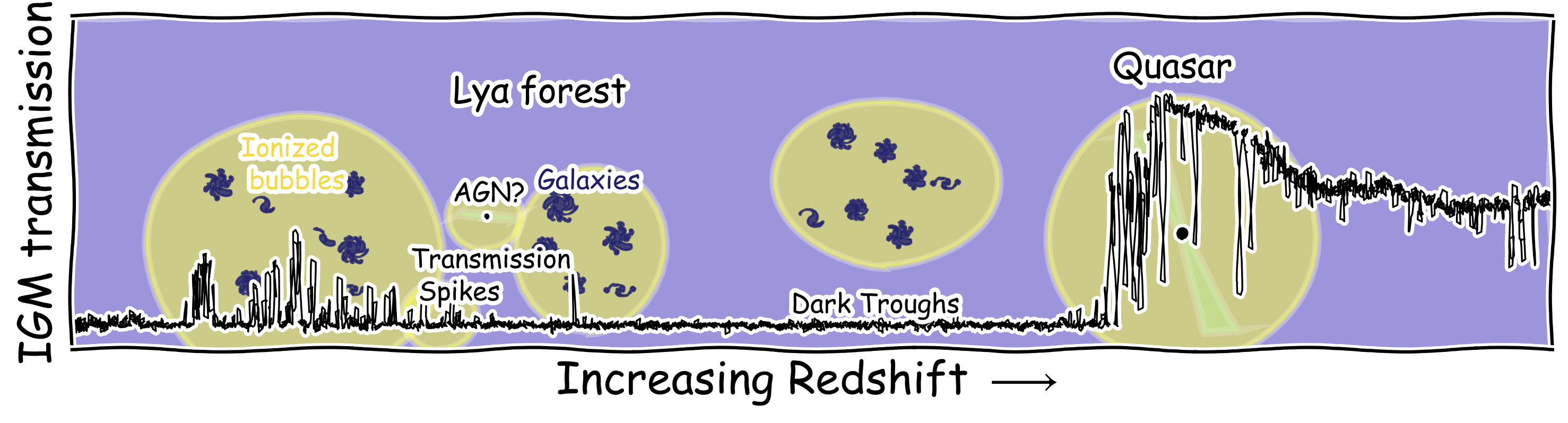 Figure: Xiangyu Jin (2025). Generated based on the X-Shooter spectrum of a quasar J0226+0302. The spatial locations of galaxies and AGN here are only for illustrative purposes. See the actual location of JWST galaxies and AGN in Jin et al., 2024 and Jin et al., 2026.
I have analyzed NIRCam Wide Field Slitless Spectroscopy (WFSS) and NIRSpec observations from multiple JWST programs including ASPIRE, COSMOS-3D, and GO 3325, together with deep spectroscopy from ground-based 6-10 m telescopes. Below are some of the projects I have been working on to explore the IGM-galaxy connection during reionization. As PI, I lead JWST Cycle 4 program GO 7436 and Roman Cycle 1 program 19053, which will further constrain reionization by mapping the IGM and the galaxy density field.
Research Projects
IGM transmission near galaxies
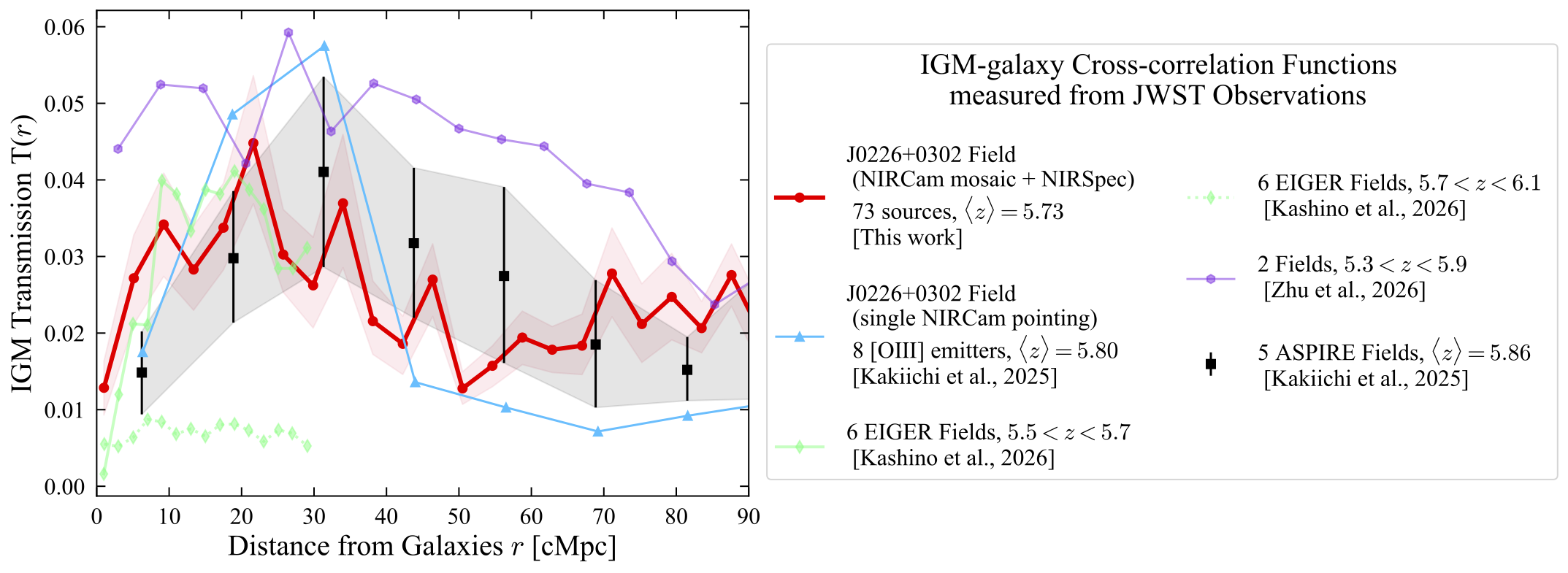
We measure the IGM transmission as a function of distance to [OIII]-emitting galaxies in 5 ASPIRE quasar fields, each observed with a single NIRCam pointing, and in one quasar field with multiple NIRCam observations. In both stuides, we find a Lyα absorption within 5-10 cMpc of the galaxies, and a 2-sigma excess IGM transmission at 10-40 cMpc, compared with the cosmic average. This suggests that the regions traced by these galaxies contribute to the local ionizing background, resulting in an excess IGM transmission. We model the ionizing photon production of the observed galaxies and find they cannot produce strong excess transmission even with an 100% ionizing photon escape fraction. Faint, undetected galaxies must also contribute to the local ionizing background.
For more details, see Jin et al. 2026 and Kakiichi, Jin et al. 2025
JWST Lyα forestGalaxiesIonized bubbles
IGM transmission near and far from galaxies
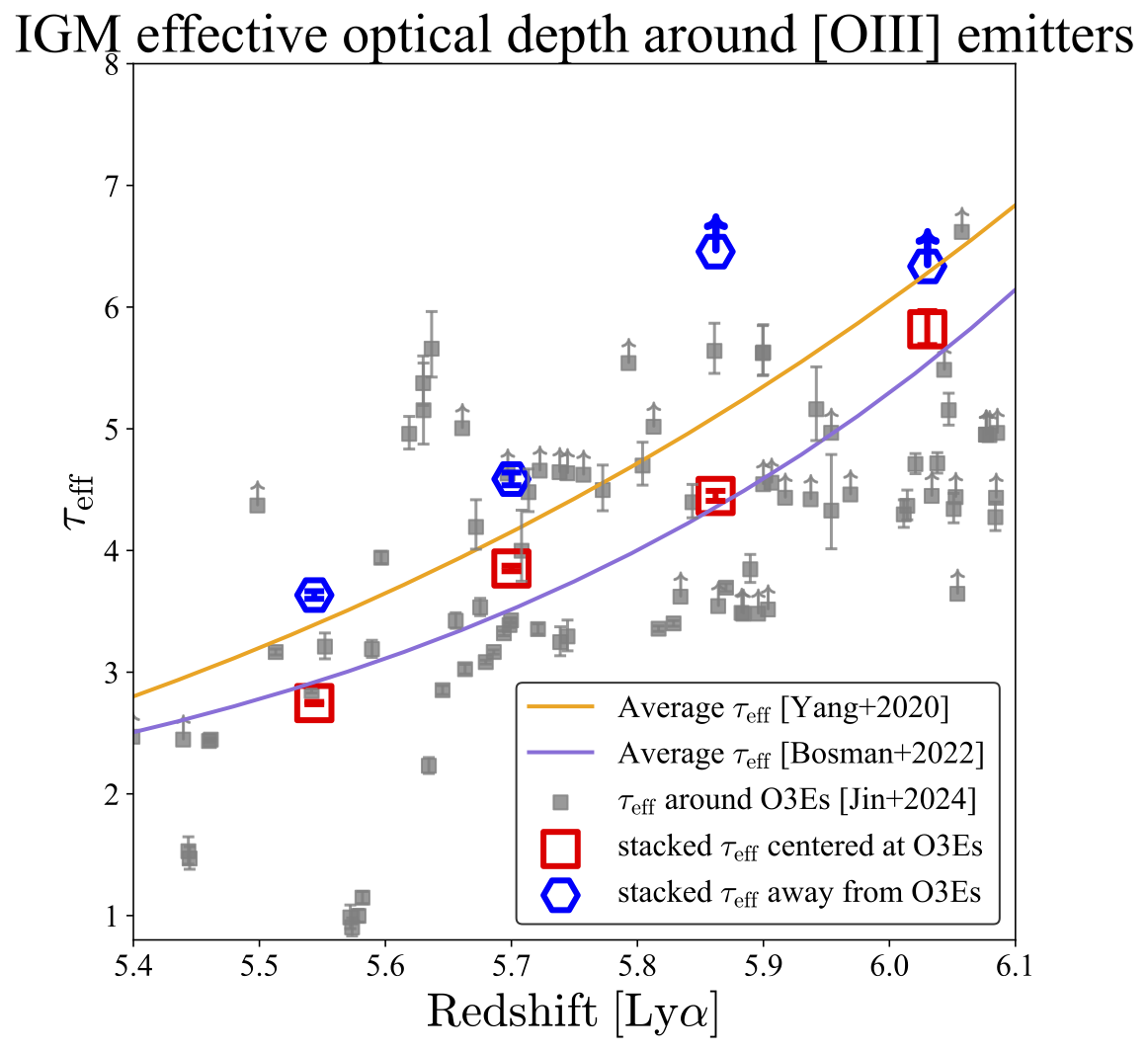
We measure the IGM effective optical depth (the optical depth of large-scale IGM transmission, measured in 50 cMpc/h bins) of IGM patches near [OIII]-emitting galaxies and farther from [OIII]-emitting galaxies at z<6. We find that regions near the [OIII]-emitting galaxies reach a given effective optical depth at least 0.1 in redshift (>=20 Myr in cosmic time) earlier than regions farther from [OIII]-emitting galaxies. This suggests that reionization happended first near the [OIII]-emitting galaxies, and later proceeded to the underdense regions without [OIII]-emitting galaxies, consistent with an “inside-out” topology of reionization.
For more details, please check Jin et al. 2024
JWST Lyα forestGalaxiesReionization topology
IGM transmission near AGN
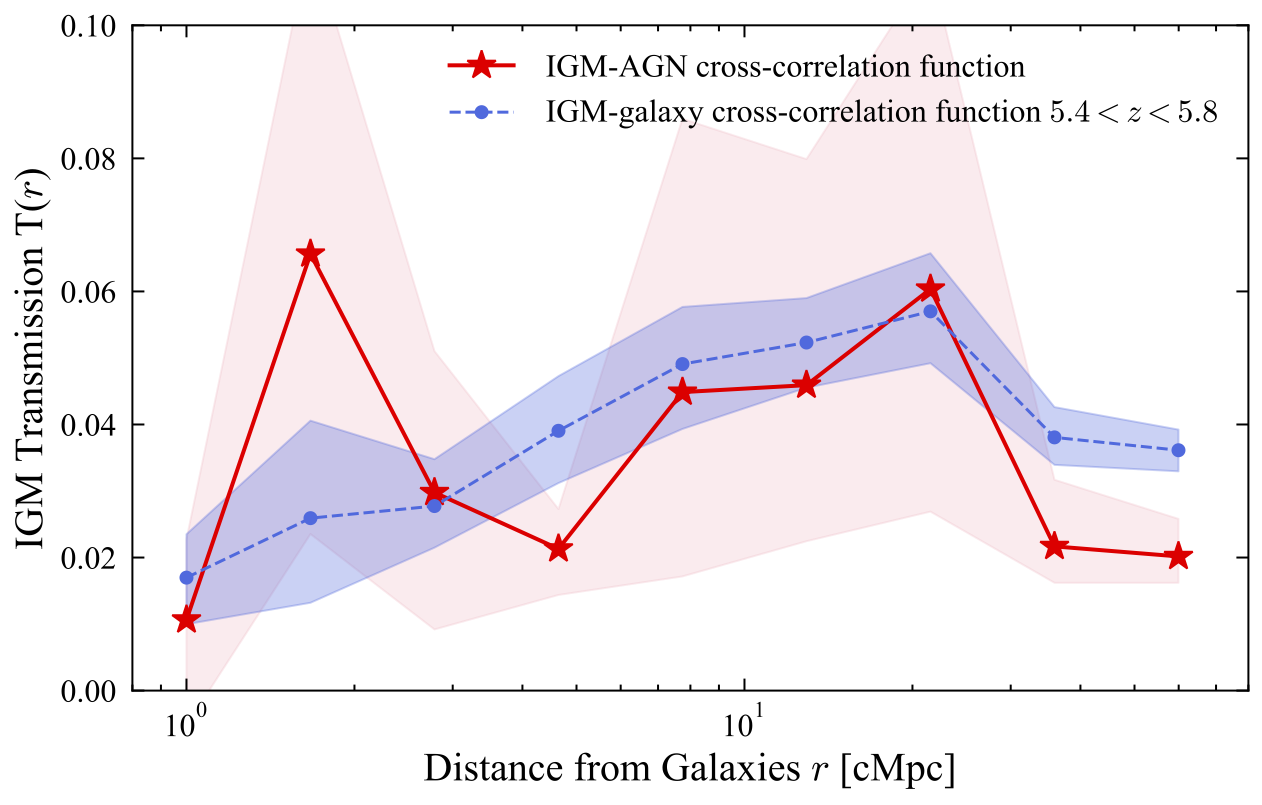
JWST has discovered abundant broad-line AGN among star-forming galaxies, however, their contribution to reionization remains unknown. With NIRSpec, we identify four broad-line AGN in the foreground of the ASPIRE quasar J0226+0302. We measure the IGM transmission as a function of the distance from the AGN. We find tentative evidence of excess IGM transmission within 5 cMpc of the AGN, relative to the transmission around galaxies. We develop an illustrative model of the AGN photoionization rate, and we find that an AGN ionizing photon escape fraction of 50%-100% is needed to explain such an excess transmission. If confirmed with more observations, this excess would indicate a major contribution of broad-line AGN to reionization.
For more details, please check Jin et al. 2026
JWST Lyα forestGalaxiesAGNIonized bubbles
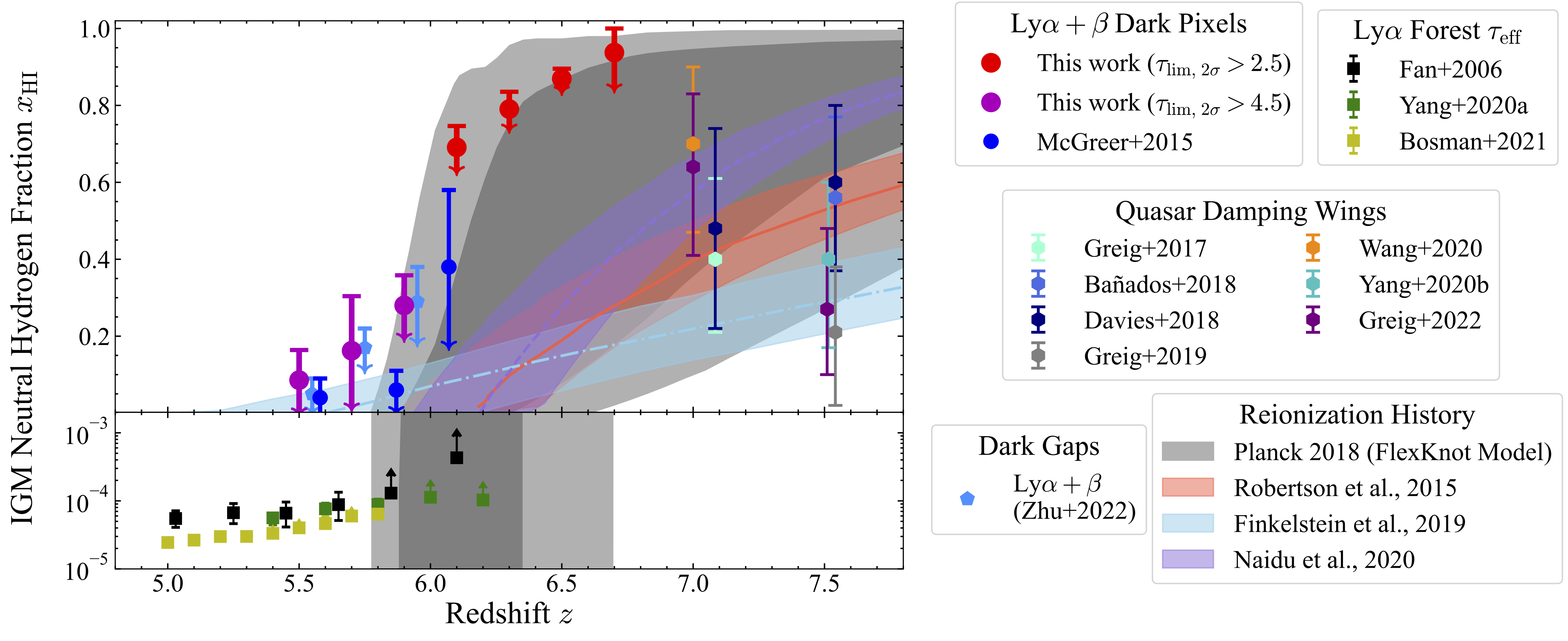
Finding dark regions in the Ly-alpha/beta forest to constrain the timing of reionization
Dark regions in the Lyα forest trace neutral gas, but their exact neutral fraction is unclear. By assuming that those dark regions fully neutral (100% neutral fraction), we obtain upper limits on the IGM neutral fraction. We measure the dark fractions of the Lyα and Lyβ forest of 53 quasars and derive upper limits on the IGM neutral fraction from z=5.1-6.8, filling a gap in previous IGM neutral fraction measurements from quasars. Our results show that reionization was still ongoing at z<6, and the IGM was not completely neutral at z=6.7, consistent with Planck 2018 results.
For more details, please check Jin et al., 2023
Ground-based Lyα forestDark pixels
Publications
Selected publications as first or second author:
X. Jin, J. Yang, F. Wang. “Probing Direct Contributions of Galaxies and AGN to Cosmic Reionization in a Quasar Field J0226+0302 with JWST NIRCam and NIRSpec.” accepted for publication in The Astrophysical Journal, 2026. arXiv:2606.14959
X. Jin, F. Wang, J. Yang, et al. “A Deep Chandra X-Ray Survey of a Luminous Quasar Sample at z ~ 7.” The Astrophysical Journal, 997, 1, 83, 2026. DOI
K. Kakiichi, X. Jin, F. Wang, et al. “JWST ASPIRE: How Did Galaxies Complete Reionization? Evidence for Excess IGM Transmission around [O III] Emitters during Reionization.” submitted to The Open Journal of Astrophysics, 2025. arXiv:2503.07074
X. Jin, J. Yang, X. Fan, et al. “A SPectroscopic survey of biased halos In the Reionization Era (ASPIRE): JWST Supports Earlier Reionization around [O III] Emitters.” The Astrophysical Journal, 976, 1, 93, 2024. DOI
X. Jin, J. Yang, X. Fan, et al. “(Nearly) Model-independent Constraints on the Neutral Hydrogen Fraction in the Intergalactic Medium at z ~ 5–7 Using Dark Pixel Fractions in Lyα and Lyβ Forests.” The Astrophysical Journal, 942, 2, 59, 2023. DOI
X. Jin, J. J. Ruan, D. Haggard, et al. “Probing the Disk–Corona Systems and Broad-line Regions of Changing-look Quasars with X-Ray and Optical Observations.” The Astrophysical Journal, 912, 1, 20, 2021. DOI
X. Jin, M. Hou, Z. Zhu, Z. Li. “Chandra Detection of Intra-cluster X-ray Sources in Fornax.” The Astrophysical Journal, 876, 53, 2019. [DOI] (Highlighted by NASA/Chandra press release)
For a full and up-to-date list, please see my NASA ADS or SciX profile.
Other Activities
I take part in outreach with UMich WISE Girls in Science and Engineering, Flandrau Planetarium, and University of Arizona WISE Imagine Your STEM Future.
Contact
- Email: jxiangyu [AT] umich [DOT] edu
- Office: Department of Astronomy, 1085 S. University, Ann Arbor, MI 48109